
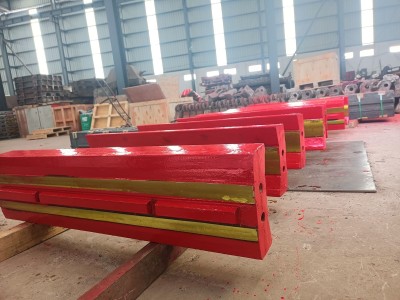
Blow bar selection is often reduced to a material comparison: high chrome, martensitic steel or ceramic composite. That shortcut misses the main engineering problem. An HSI blow bar must resist wear while repeatedly accepting impact inside a specific rotor. The right route depends on the balance between abrasion and impact, not on which material name sounds more advanced.
A useful review begins with the current failure evidence, feed hazards and rotor interface. Only then should the candidate matrix and any composite reinforcement be selected.
Define the real duty before comparing materials
Collect the following operating information:
- crusher manufacturer, model, serial range and rotor configuration;
- current blow bar part number, drawing or identified sample;
- feed material, maximum feed size and expected contaminants;
- primary, secondary or recycling duty;
- rotor speed or approved operating range;
- current material and known heat treatment;
- campaign tonnage or hours;
- wear profile across the bar;
- breakage, chipping, insert loss or seating damage;
- changes in feed preparation, recirculation or apron setting.
Tramp metal and uncrushable feed deserve separate attention. A material route selected for clean, abrasive stone may not be suitable for a recycling stream with unpredictable impact events.
Match the candidate route to impact and abrasion
The following comparison is a screening framework, not a final specification.
| Candidate route | Why it may be reviewed | What must be checked |
|---|---|---|
| Martensitic steel | A balance of wear resistance and impact tolerance for selected duties | Feed impact, section, heat treatment, hardness distribution and breakage history |
| High-chrome iron | Strong abrasion resistance where impact risk is controlled | Tramp events, feed size, support geometry, casting integrity and brittle-damage evidence |
| Ceramic composite | Reinforced wear zones within a metallic matrix | Matrix choice, insert design and position, impact exposure, bonding and acceptance criteria |
| Manganese steel | Work-hardening route for selected high-impact conditions | Whether service develops useful work hardening and whether abrasive loss remains acceptable |
These routes are not interchangeable by name alone. “Ceramic” can describe different insert systems and matrices. “High chrome” can cover different chemistry and heat-treatment windows. The quotation and order specification should define the actual construction and inspection scope.
Read the worn blow bar before changing it
The removed part contains information about both operation and fitment.
Uniform abrasive loss
If the bar loses section evenly without cracking, compare wear rate and cost per tonne under controlled operating conditions. Confirm that usable profile, starting mass and feed were comparable.
Local chipping or fracture
Locate the initiation area. Review tramp events, casting discontinuities, notch geometry, bar seating, wedge condition and rotor contact before deciding that a harder material is needed. Increasing abrasion resistance can be counterproductive if impact damage is already controlling life.
Uneven wear across the rotor width
Check feed distribution, rotor loading, apron condition and recirculation. A material change does not correct a process that consistently loads one end of the bar.
Movement or damage at the seat
Inspect the blow bar, wedges, rotor slot and adjacent protection parts as one interface. Reusing worn retaining components can change contact and load transfer. Final assembly and tightening must follow the applicable machine procedure.
Fitment and set control come before performance claims
The blow bar must match the rotor slot, contact faces and retaining system. Supply evidence should cover the drawing revision or verified sample, critical dimensions and agreed mass tolerance.
Because the bars rotate as a set, replacement planning should also consider:
- whether bars are replaced as a complete or approved matched set;
- individual and set weights;
- orientation and rotor position;
- wedge and locking-component condition;
- clearance to rotor protection and apron components;
- the machine maker’s balancing and commissioning procedure.
Do not use a generic balance value from another rotor family. The applicable machine documentation and approved maintenance procedure control the assembly.
Evaluate a trial with more than service hours
A trial should capture:
- new bar identity, material route and set weights;
- installation date, rotor positions and associated retaining parts;
- feed and operating changes during the campaign;
- abnormal events, stoppages and reversals where applicable;
- processed tonnage or operating hours;
- removed weights and wear profile;
- cracks, chips, insert condition and seat condition;
- component cost per tonne and change-out consequences.
The conclusion may be that one route wears more slowly but carries higher breakage risk, or that a balanced route produces a lower total operating cost. That is more useful than an unsupported claim that one construction lasts a fixed multiple longer.
Build the quotation around the decision you need to make
Send the machine and rotor reference, current blow bar identity, feed description, maximum feed size, current material, wear photographs, failure history, quantity and required records. If the objective is to compare martensitic, high-chrome and composite routes, state the baseline and the acceptance criteria for the trial.
Use the technical quotation form to attach the available drawing or worn-part photographs.