
1. Record the observed failure
- Premature wear
- Cracking or breakage
- Uneven wear
- Mounting or interface damage
Evidence: removed-part photographs, measurements, failure location and maintenance notes.
Measurement tags start with analytics and advertising storage denied. Accepting enables optional measurement and advertising; rejecting keeps them off. Privacy Notice.
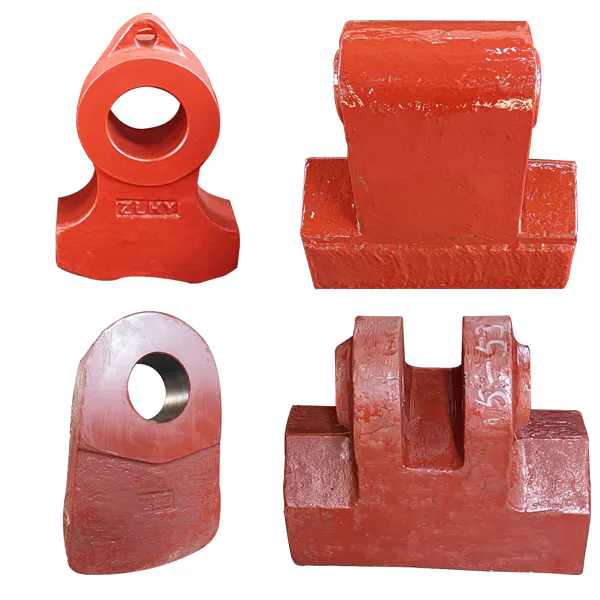
Rotor-mounted impact wear part
Hammer or hammer head transferring rotor energy to the feed material. ZL reviews identification, service duty, material route and inspection requirements before production or matched supply.
Technical content reviewed by ZL Crusher Parts Engineering Team · · Company evidence boundaries
The Crusher Hammer supply route is released only after the available reference and critical interfaces are reviewed. Material, inspection and document requirements must be stated in the quotation and purchase specification.
Crusher Hammer Head
This page is the technical and commercial entry point for “Crusher Hammer Head”. It covers four distinct buyer tasks without treating a model name as a fitment guarantee.
Identification evidence comes first. Application and failure data then determine the material, construction and inspection route.
OEM reference-check library
This is a reference-search library, not a fitment guarantee. Final compatibility is released only against the OEM part number, serial range, approved drawing, sample or verified critical dimensions.
Select a model to carry the machine reference into the technical inquiry.
Manufacturer names and model designations are used only to identify compatible replacement-part references. ZL is not affiliated with the listed OEMs.
The recommendation follows the observed failure mode and actual operating duty. No service-life multiplier is stated without comparable field evidence.
Evidence: removed-part photographs, measurements, failure location and maintenance notes.
Evidence: machine records, process information, operating conditions and comparable service history.
Use a verified standard reference where available. Use the custom route when geometry, material or assembly history differs.
Review these criteria, then select the required route in the single technical inquiry form below.
A material name alone does not establish suitability. The current part, duty, failure pattern, geometry and required inspection plan are reviewed together.
High-chrome iron, Manganese steel, Alloy steel, Bimetal, Ceramic composite are enquiry routes recorded for this product family. Final grade, chemistry, heat treatment, hardness, construction and acceptance criteria must be agreed in the quotation and purchase specification.
Review these criteria, then select the required route in the single technical inquiry form below.
Public grade names are only the starting point. The quotation and purchase specification define the measurable acceptance data for the supplied part.
| Data item | What can be agreed | Publishing boundary |
|---|---|---|
| Candidate material route | High-chrome iron / Manganese steel / Alloy steel / Bimetal / Ceramic composite | Candidate routes only; suitability follows application review. |
| Chemical composition | Heat- or batch-linked analysis against agreed limits | Limits and sampling are defined in the order specification. |
| Hardness | Method, test locations, sampling and acceptance range | No single hardness value applies to every section or duty. |
| Heat treatment | Grade- and section-specific process route and agreed record scope | The detailed production route is order controlled. |
| Traceability | Order identification, heat/batch link and part marking | Required marking and dossier are stated before production. |
Use the custom route when no reliable standard reference exists, the machine has been modified or the existing crusher hammer requires a controlled geometry or material change.
Manufacturing does not begin from an unverified worn shape or an unsupported model assumption. Missing datums, interfaces and acceptance criteria are identified before quotation.
Review these criteria, then select the required route in the single technical inquiry form below.
Send the approved drawing and revision. Mark drawing and revision, critical dimensions and interfaces, material and inspection scope, part marking and packing scope and the required inspection points.
Provide an identified sample and its service history. Engineering separates preserved interfaces from worn or damaged geometry.
Provide controlled measurements for drawing and revision, critical dimensions and interfaces, material and inspection scope, part marking and packing scope with clear datums and mating-part context.
Required records, methods, locations, sampling and acceptance criteria must be written into the quotation and purchase order.
| Document or record | Purpose | How to handle |
|---|---|---|
| Drawing, revision and order identification | Links the supplied Crusher Hammer to the agreed technical reference | Confirm in quotation |
| Material and heat/batch record | Supports traceability to the agreed material route | When specified |
| Dimensional and visual inspection | Checks drawing and revision, critical dimensions and interfaces, material and inspection scope, part marking and packing scope | Define sampling |
| Hardness, NDT or third-party witness | Adds order-specific control where technically applicable | Project review |
The company record supports the operating capability below. The inspection plan for a supplied part is defined in the quotation and purchase specification.
A documented hammer order includes drawing-linked dimensions, weight checks, base and hardfacing hardness, chemical composition, penetrant inspection and finished-part photographs.
This is evidence of an executed inspection route, not a promise that every order includes the same tests. Required records and acceptance criteria must be agreed before production.
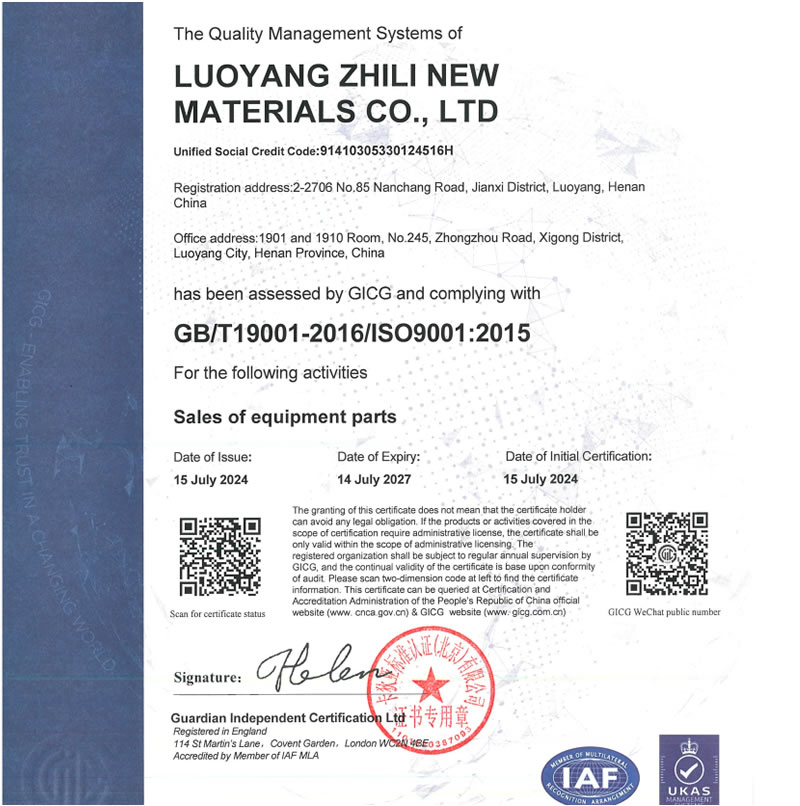
Certified scope shown on the document: Sales of equipment parts.
ZL is an integrated manufacturer and exporter with its own production facilities. The wording above is the scope of this certificate, not a description of the company’s full operating capabilities or a product-specific certification.
Published field evidence
These three records concern crusher hammers. They demonstrate ZL’s field-follow-up and evidence-handling capability; they are not performance claims for Crusher Hammer: Rotor-mounted impact wear part.
Insert-bar crusher hammers
A customer performance table records 70 insert-bar hammers from new to used condition and the limestone tonnage processed during the test period.
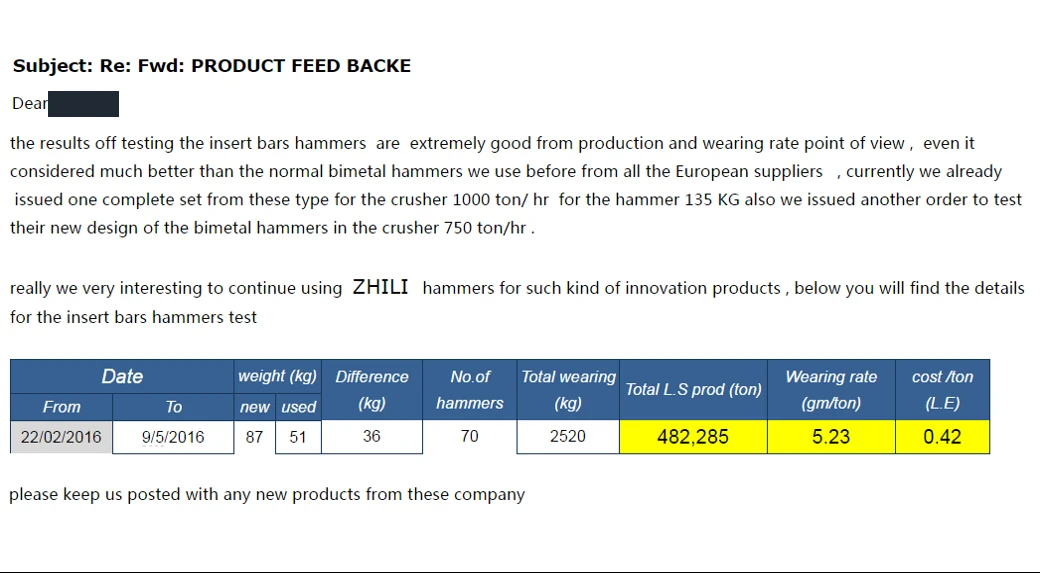
The same customer message states that a complete set was issued for a 1,000 t/h crusher and another design was ordered for testing on a 750 t/h crusher.
Source: customer email and attached wear table.
Evidence boundary
The operating site and feed specification are not publicly disclosed. The figures are customer-reported, not an independent laboratory result.
Hardfaced crusher hammers
A Romanian-crusher worksheet compares recorded hammer campaigns. The disclosed ZL-supplied hardfaced row shows a lower recorded cost per tonne but a higher wear rate than the European benchmark rows.
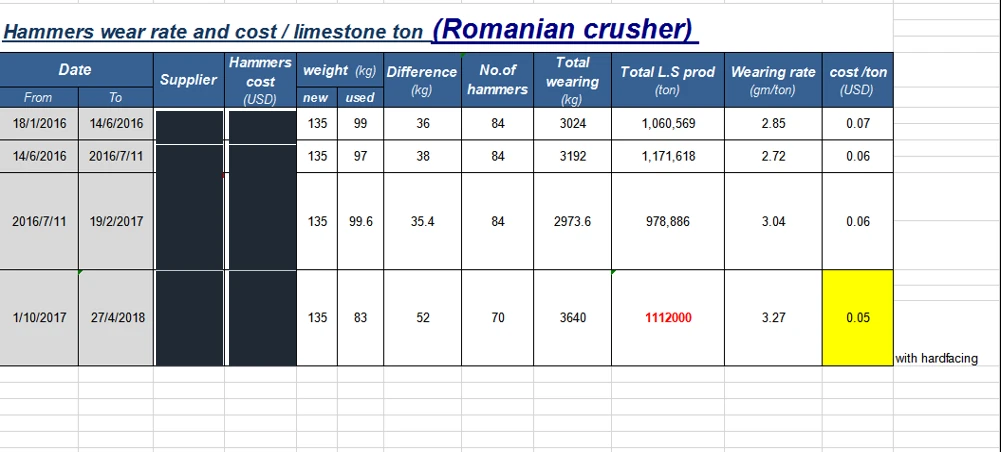
European benchmark rows in the same worksheet record 2.72–2.85 g/t and USD 0.06–0.07/t. This is presented as a cost-versus-wear trade-off, not a wear-life superiority claim.
Source: customer-maintained comparative wear worksheet.
Evidence boundary
Campaign conditions may differ. The record does not establish a controlled same-condition laboratory comparison.
Raw-material crusher hammers
A maintenance supervisor at a Turkish cement producer wrote that the four-month performance was liked and that purchasing would make contact regarding two hammer types.
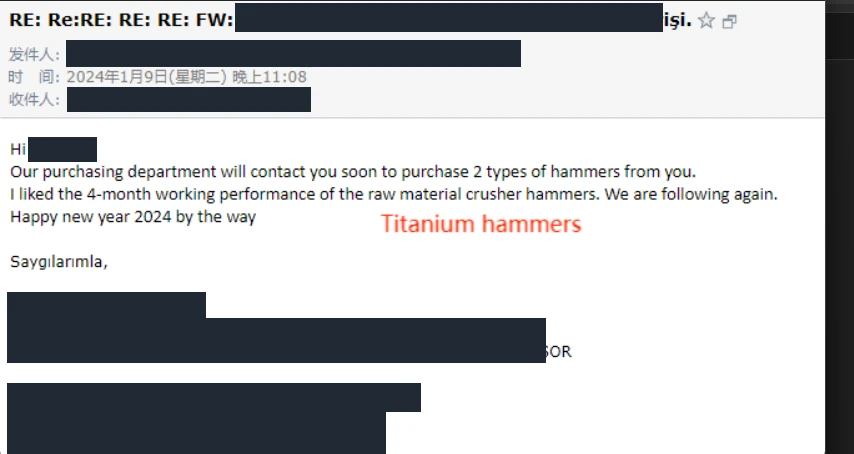
This supports a positive follow-up and purchase discussion. It does not prove that a repeat order was completed.
Source: customer email; company and personal details are withheld.
Evidence boundary
No tonnage, wear rate or completed purchase record is stated in the supplied evidence, so none is claimed here.
Customer identities and personal data are withheld. Original records can be reviewed under an appropriate commercial confidentiality process.
Use the closest part family as the search entry. The same technical inquiry route carries the machine, part and evidence context into the quotation form.
Yes. Start with the machine model, an approved drawing, an identified sample or verified dimensions. Engineering will identify missing drawing and revision, critical dimensions and interfaces, material and inspection scope, part marking and packing scope before quotation.
There is no universal answer. Candidate routes include High-chrome iron, Manganese steel, Alloy steel, Bimetal, Ceramic composite. Selection depends on duty, geometry, failure mode and the required inspection plan.
Yes, when the available drawing, sample or controlled dimensions are sufficient to confirm interfaces and acceptance criteria before production.
The normal review starts from Drawing revision · Material record · Critical dimensions · Hardness · Visual inspection. The exact methods, sampling and acceptance criteria must be agreed for the order.
Complete the technical step first. The quote page then collects contact details, files and a Privacy Notice acknowledgment. Unknown fields can be marked for engineering review.