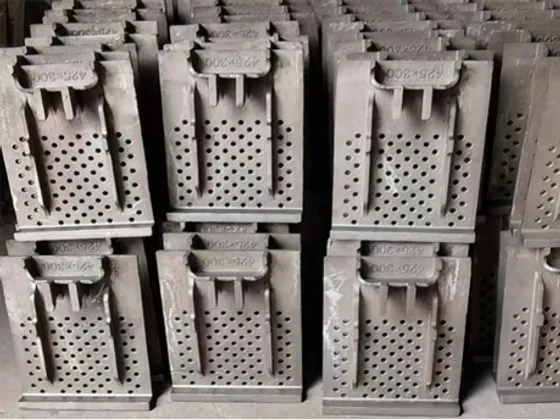
Chain Sprockets / Chain Wheels
Thermal cycling, oxidation and abrasion cause deformation or cracking in hot-zone castings.
Chain Sprockets / Chain Wheels — heat-resistant castings for clinker coolers, rotary kilns, preheaters and material handling systems. OEM-compatible supply, custom casting and machining, material certificates included.
Cast alloy steel + induction-hardened tooth flanks (HRC 52-58). Monobloc or segmented rim. Fits Tsubaki, Hetai, RUD, Renold, Wulf & Chinese chain pitches.
For a quote, send the OEM part number, equipment model, drawing or worn-part photos. We can match Chain Sprockets / Chain Wheels by dimensions, alloy grade, operating position and application conditions.
Request a Quote24-hour response · Send drawing or sample
At a glance
Engineers
Check fitment, alloy grade, wear position, drawings and operating conditions before selecting Chain Sprockets / Chain Wheels.
Procurement
Quote requests are matched by OEM reference, equipment model, quantity, lead time and export documents.
Quality
Material certificates, hardness checks, dimensional inspection and traceability records can ship with the order.
Send model, OEM reference or drawing. We check the replacement route first.
Supply grate plates, cooler parts, kiln nose ring segments and heat-resistant castings by temperature zone.
Before quoting, we check
- Operating temperature
- Thermal shock frequency
- Oxidation, abrasion and load conditions
Documents we can verify
- ✔ Heat-zone material selection
- ✔ Dimensional inspection after heat-resistant casting
- ✔ Certificates for alloy chemistry
Fitment workflow
Confirm temperature zone
Review worn-part photos
Select heat-resistant alloy
Check dimensions and certificate requirements
RFQ desk
Pricing for Chain Sprockets / Chain Wheels
Send the OEM reference, machine model, drawing or worn-part photos. We respond within 24 hours.
What should be checked before selecting Chain Sprockets / Chain Wheels?
This section is the working structure for product-level performance data. It avoids fake numbers now, but keeps the page ready for real wear-life, output and cost-per-ton records when you provide them.
| Metric | Needed from buyer | Why it matters |
|---|---|---|
| Temperature zone | Normal and peak operating temperature | Controls heat-resistant alloy and oxidation resistance. |
| Thermal shock | Shutdown frequency and cooling cycle | Thermal cycling can cause cracking even when wear is low. |
| Load and abrasion | Material flow, clinker size and impact area | Determines whether heat resistance or abrasion resistance dominates. |
Common failure modes we check before recommending this part
Warping or deformation
Likely cause
Temperature above alloy range or overload
What we check
Temperature zone, geometry and support condition.
Cracking after shutdown
Likely cause
Thermal shock or stress concentration
What we check
Cooling cycle, casting design and crack location.
Surface scaling
Likely cause
Oxidation or chemical attack
What we check
Gas environment, temperature and alloy chemistry.
What are the full specifications?
Which material is right for your application?
Which Alloy for Your Temperature Zone?
High-temperature castings require correct Ni content and microstructure. Wrong grade = premature failure and kiln stop.
A. Heat-Resistant Alloy Grades by Temperature Zone
| Grade | Cr-Ni % | Max Temp | Strengthening | Key Application | Typical Life |
|---|---|---|---|---|---|
| HH (25Cr-12Ni) | 25 / 12 | 650 °C | As-cast carbide | Cooler discharge grates, dip tubes | 12,000-20,000 hrs |
| HK (25Cr-20Ni) | 25 / 20 | 850 °C | As-cast carbide network | Cooler mid-zone grates, side plates | 8,000-15,000 hrs |
| HP (25Cr-35Ni) | 25 / 35 | 1,050 °C | Eutectic carbide, creep-resistant | Cooler hot zone, kiln inlet | 4,000-10,000 hrs |
| HP-Nb (25Cr-35Ni+Nb) | 25 / 35 + Nb | 1,200 °C | Niobium carbide, sigma-phase control | Cooler bull nose, kiln nose ring | 2,000-6,000 hrs |
B. Chain System & General Wear Castings
| Part | Operating Condition | Recommended Grade | Hardness / Max Temp | Typical Life | Failure Consequence |
|---|---|---|---|---|---|
| Sprocket (raw meal elevator) | Ambient, high-cycle contact | 42CrMo + tooth IH | HRC 52-58 | 15,000-25,000 hrs | Chain skip, production stop |
| Sprocket (clinker elevator) | 200-350 °C, abrasive dust | Cast Cr-Mo + tooth IH | HRC 50-55 | 8,000-15,000 hrs | Accelerated chain wear |
| Elevator Bucket (raw meal) | Ambient, abrasive | High-Cr Cast Iron | HRC 55-60 | 10,000-18,000 hrs | Material spillage |
| Elevator Bucket (clinker) | 250-400 °C, abrasive | Ni-Hard 4 | HRC 55-60 / 450 °C max | 6,000-12,000 hrs | Hot clinker spill = fire risk |
| Drag Chain Flight (clinker) | Ambient, high abrasion | Ni-Hard 4 / Cr26 | HRC 55-62 | 4,000-8,000 hrs | Material carryover |
| Chute Liner (abrasive flow) | Ambient to 400 °C | Cr26 Overlay / Ceramic | HRC 58-62 / 70+ | 12,000-20,000 hrs | Housing damage |
Three Rules for Heat-Resistant Casting Economics
① Nickel content = creep resistance = cost. Ni goes from 12% (HH) to 35%+Nb (HP-Nb). Each 10% Ni increment adds significant cost to the casting. Selecting HP-Nb where HK would work wastes money. Selecting HK where HP-Nb is needed costs a kiln stop.
② Sigma phase embrittlement is the silent killer. Prolonged exposure at 600-900 °C causes chrome-rich sigma phase precipitation in the grain boundaries of HK/HP alloys. HP-Nb with niobium stabilization resists this. Catastrophic brittle fracture during shutdown restart.
③ Chain itself is not a casting product \u2014 but sprockets, buckets, and flights are. Do not supply chain links, pins, or bushings \u2014 these are forged/machined products outside your foundry capability. Focus on the cast components that interface with the chain system.
Which crusher models does this part fit?
Model names show our reference-checking coverage. Final fitment is confirmed against the OEM reference, drawing or part dimensions before production.
Tsubaki
RUD
Chinese OEM
FLSmidth
KHD Humboldt Wedag
Sinoma / Chinese OEM
Polysius / ThyssenKrupp
Elevator & Chain Systems
Why choose ZL Crusher Parts
Foundry-direct. No middleman.
30+ years casting experience. 18,000-ton annual capacity. Every part engineered, poured, heat-treated, machined, and QC-checked in our own Luoyang plant. No outsourcing, no sub-contracting. ISO 9001:2015.
9-step QC. Full traceability.
Spectrometer → metallurgical microscope → impact tester → tensile machine → hardness tester → 3D scanner → ultrasonic → magnetic particle → portable spectrometer. Every inspection report ships with your order.
Global. Trusted by industry leaders.
Exported to 37+ countries across four global regions. Supplying CEMEX, LafargeHolcim, Heidelberg Cement, TATA Steel and POSCO. Official Hardox® Wear Parts Center since 2017.
What are the most common questions about this part?
Why induction-hardened teeth? +
Tooth flanks see 1–10 million impact cycles per year. Induction hardening extends tooth life 2–3× over through-hardened teeth at minimal cost premium.
Can you match Chain Sprockets / Chain Wheels without an OEM part number? +
Yes. Send the machine make and model, worn-part photos, key dimensions or a drawing. We check the fitment route before quoting and confirm what information is still missing.
Which material grade should I choose for Chain Sprockets / Chain Wheels? +
Material selection depends on feed material, impact level, abrasion, operating temperature and the position of the part. We compare your application against the current wear pattern before recommending a grade.
What information do you need for a useful quote? +
The fastest quote comes with equipment model, OEM reference if available, quantity, target delivery date, feed material, working position and any photos or drawings of the existing part.
Do you supply certificates and inspection records? +
Yes. Material certificates, chemistry, hardness checks, dimensional inspection and traceability records can be supplied with the order when requested.
What should you prepare before requesting a quote?
- 1 Crusher make, model, and OEM part number
- 2 Feed material type and hardness
- 3 Required quantity and target delivery date
- 4 Special requirements (certifications, custom packaging)
24-hour response · Send drawing or sample
What other crusher wear parts are commonly needed together?
Clinker Cooler Grate Plates / Cooler Grates
Clinker Cooler Grate Plates / Cooler Grates — heat-resistant castings for clinker coolers, rotary kilns, preheaters and material handling systems. OEM-compatible supply, custom casting and machining, material certificates included.
View details: Clinker Cooler Grate Plates / Cooler Grates →Rotary Kiln Nose Ring Segments / Outlet Segments
Rotary Kiln Nose Ring Segments / Outlet Segments — heat-resistant castings for clinker coolers, rotary kilns, preheaters and material handling systems. OEM-compatible supply, custom casting and machining, material certificates included.
View details: Rotary Kiln Nose Ring Segments / Outlet Segments →Clinker Cooler Side Plates / Sealing Plates
Clinker Cooler Side Plates / Sealing Plates — heat-resistant castings for clinker coolers, rotary kilns, preheaters and material handling systems. OEM-compatible supply, custom casting and machining, material certificates included.
View details: Clinker Cooler Side Plates / Sealing Plates →Preheater Dip Tubes / Immersion Tubes
Preheater Dip Tubes / Immersion Tubes — heat-resistant castings for clinker coolers, rotary kilns, preheaters and material handling systems. OEM-compatible supply, custom casting and machining, material certificates included.
View details: Preheater Dip Tubes / Immersion Tubes →