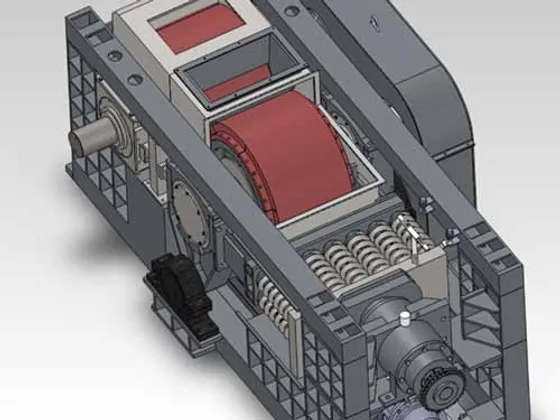
Roller Press Side Wear Plates / Cheek Plates
Stud loss or roller surface damage quickly spreads and destabilizes the grinding bed.
Roller Press Side Wear Plates / Cheek Plates — roller press and HPGR wear parts for cement grinding, slag grinding and mining applications. OEM-compatible supply, custom casting and machining, material certificates included.
Hardox 500, Cr26, or HB400+ceramic. Seals the roller gap. Material bypass through worn plates drops grinding pressure and roller efficiency by 15–30%.
For a quote, send the OEM part number, equipment model, drawing or worn-part photos. We can match Roller Press Side Wear Plates / Cheek Plates by dimensions, alloy grade, operating position and application conditions.
Request a Quote24-hour response · Send drawing or sample
At a glance
Engineers
Check fitment, alloy grade, wear position, drawings and operating conditions before selecting Roller Press Side Wear Plates / Cheek Plates.
Procurement
Quote requests are matched by OEM reference, equipment model, quantity, lead time and export documents.
Quality
Material certificates, hardness checks, dimensional inspection and traceability records can ship with the order.
Send model, OEM reference or drawing. We check the replacement route first.
Supply roller tyres, wear studs, edge blocks and side plates for cement roller press systems.
Before quoting, we check
- Roller surface type
- Stud retention history
- Feed moisture and pressure settings
Documents we can verify
- ✔ Stud layout and edge protection review
- ✔ Hardness and bonding checks
- ✔ Failure-mode guidance before quote
Fitment workflow
Map stud loss area
Confirm roller dimensions
Review feed and pressure data
Select repair or replacement scope
RFQ desk
Pricing for Roller Press Side Wear Plates / Cheek Plates
Send the OEM reference, machine model, drawing or worn-part photos. We respond within 24 hours.
What should be checked before selecting Roller Press Side Wear Plates / Cheek Plates?
This section is the working structure for product-level performance data. It avoids fake numbers now, but keeps the page ready for real wear-life, output and cost-per-ton records when you provide them.
| Metric | Needed from buyer | Why it matters |
|---|---|---|
| Stud retention | Photos of lost studs and running hours | One lost stud can accelerate surrounding surface wear. |
| Roller pressure | Operating pressure and feed moisture | Controls compacted bed behaviour and edge wear. |
| Edge condition | Edge block photos and side wear pattern | Edge failure spreads into the working surface. |
Common failure modes we check before recommending this part
Stud loss
Likely cause
Bonding failure, feed impact or local overload
What we check
Stud map, hardness, edge condition and pressure history.
Edge chipping
Likely cause
Side overload or feed distribution issue
What we check
Edge block condition and feed distribution.
Grinding bed instability
Likely cause
Uneven wear or moisture change
What we check
Wear surface, pressure and feed moisture.
What are the full specifications?
Which material is right for your application?
Which Configuration for Your Application?
Roller press wear economics are dominated by stud retention and rebuild cycle count. Choose the right configuration for your feed material and grinding circuit.
A. Roller Tyre Configuration Decision
| Configuration | Application | Base Material | Surface | Maintenance | Typical Life | Relative Cost |
|---|---|---|---|---|---|---|
| Studded | Cement finish grinding | Cr-Mo alloy steel | WC-Co pins (HV 1,400+) | Pin replacement, not full rebuild | Application-dependent | Highest barrier / value |
| Hardfaced | Cement raw / slag grinding | Cr-Mo forged ring | Periodic hardfacing weld overlay | Rebuild cycles based on wear | Application-dependent | Lowest lifetime cost |
| Monobloc Cast | Mining HPGR (Cu/Au/Fe) | Cr-Mo / Ni-Hard 4 | As-cast or machined profile | Replace when past rebuild limit | Application-dependent | Medium |
B. Ancillary Parts Material Guide
| Part | Grade | Hardness | Typical Life | Failure Consequence If Ignored |
|---|---|---|---|---|
| Side Wear Plates (cement) | Hardox 500 / Cr26 | HB 500 / HRC 58–62 | Application-dependent | 15–30% efficiency loss |
| Side Wear Plates (HPGR) | Cr26 + Ceramic insert | HRC 58–62 / 70+ | Application-dependent | Rapid edge wear, roller damage |
| Scraper Blades | WC insert + Hardox base | WC HV 1,800+ | Application-dependent | Stud loss / hot spots on roller |
| Feed Chute Liners | HB400 / Hardox 450 | HB 400–450 | Application-dependent | Uneven roller wear = 50% life reduction |
Three Rules for Roller Press Wear Economics
① One lost stud triggers a chain reaction. When one WC pin detaches, material gets trapped in the void, scouring the Cr-Mo base around neighboring pins. Within weeks, 4\u20136 adjacent pins follow. Within 3 months, the roller surface is ruined. Stud retention is the #1 quality metric.
② Side wear plates are the invisible cost driver. When cheek plates wear, material bypasses the roller gap. Grinding pressure drops, roller efficiency falls 15\u201330%, and the entire grinding circuit throughput suffers. Replace cheek plates alongside every roller maintenance interval.
③ Hardfaced rollers are rebuildable \u2014 but only if the base ring is sound. Quality Cr-Mo forged base rings survive 5\u20138 rebuild cycles before fatigue cracks appear. A poor base ring fails in 2\u20133 cycles. The base ring casting quality determines the lifetime economics of a hardfaced roller system.
Which crusher models does this part fit?
Model names show our reference-checking coverage. Final fitment is confirmed against the OEM reference, drawing or part dimensions before production.
FLSmidth
KHD
Koppern
KHD Humboldt Wedag
Koppern / Maschinenfabrik Koppern
ThyssenKrupp / Polysius
Metso / Outotec
Chinese OEM (CITIC / Sinoma / Hefei / Chengdu)
Why choose ZL Crusher Parts
Foundry-direct. No middleman.
30+ years casting experience. 18,000-ton annual capacity. Every part engineered, poured, heat-treated, machined, and QC-checked in our own Luoyang plant. No outsourcing, no sub-contracting. ISO 9001:2015.
9-step QC. Full traceability.
Spectrometer → metallurgical microscope → impact tester → tensile machine → hardness tester → 3D scanner → ultrasonic → magnetic particle → portable spectrometer. Every inspection report ships with your order.
Global. Trusted by industry leaders.
Exported to 37+ countries across four global regions. Supplying CEMEX, LafargeHolcim, Heidelberg Cement, TATA Steel and POSCO. Official Hardox® Wear Parts Center since 2017.
What are the most common questions about this part?
What is the cost of worn side wear plates? +
Roller efficiency drops 15–30% as material bypasses the worn gap. The entire grinding circuit throughput suffers — often more than the price of the plates themselves.
Can you match Roller Press Side Wear Plates / Cheek Plates without an OEM part number? +
Yes. Send the machine make and model, worn-part photos, key dimensions or a drawing. We check the fitment route before quoting and confirm what information is still missing.
Which material grade should I choose for Roller Press Side Wear Plates / Cheek Plates? +
Material selection depends on feed material, impact level, abrasion, operating temperature and the position of the part. We compare your application against the current wear pattern before recommending a grade.
What information do you need for a useful quote? +
The fastest quote comes with equipment model, OEM reference if available, quantity, target delivery date, feed material, working position and any photos or drawings of the existing part.
Do you supply certificates and inspection records? +
Yes. Material certificates, chemistry, hardness checks, dimensional inspection and traceability records can be supplied with the order when requested.
What should you prepare before requesting a quote?
- 1 Crusher make, model, and OEM part number
- 2 Feed material type and hardness
- 3 Required quantity and target delivery date
- 4 Special requirements (certifications, custom packaging)
24-hour response · Send drawing or sample
What other crusher wear parts are commonly needed together?
Roller Press Roller Tyres / Studded Rolls
Roller Press Roller Tyres / Studded Rolls — roller press and HPGR wear parts for cement grinding, slag grinding and mining applications. OEM-compatible supply, custom casting and machining, material certificates included.
View details: Roller Press Roller Tyres / Studded Rolls →Roller Press Scraper Blades / Cleaning Scrapers
Roller Press Scraper Blades / Cleaning Scrapers — roller press and HPGR wear parts for cement grinding, slag grinding and mining applications. OEM-compatible supply, custom casting and machining, material certificates included.
View details: Roller Press Scraper Blades / Cleaning Scrapers →Roller Press Feed Chute & Hopper Liners
Roller Press Feed Chute & Hopper Liners — roller press and HPGR wear parts for cement grinding, slag grinding and mining applications. OEM-compatible supply, custom casting and machining, material certificates included.
View details: Roller Press Feed Chute & Hopper Liners →